PROTECT YOUR LOVED ONES AND YOURSELF AGAINST ANNOYING AND EVEN DANGEROUS INSECTS.
By: Henk Kraaijvanger.
It seems to me that more troublesome and dangerous insects are appearing here than in the past. We also travel more often to their native regions, and they can hitch a ride home after distant holidays. Tropical species include the yellow-fever mosquito, Aedes aegypti, which spreads yellow fever, dengue, chikungunya and the Zika virus found particularly in South America.
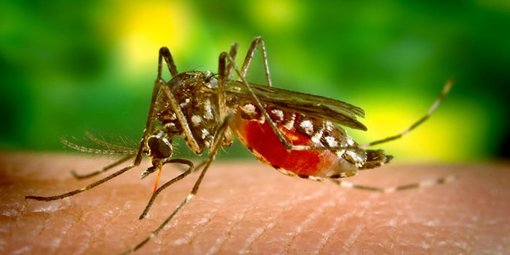
An Aedes mosquito.
TRANSMISSION.
Zika can also be transmitted sexually. For a long time, only one person in the United States was known to have contracted it through sexual contact with an infected person from a country where the virus circulates. The virus had already been found in human semen. In early March, however, the World Health Organization (WHO) announced that sexual transmission was more common than previously thought. On 5 February, Zika researchers reported finding the virus in saliva and urine too. They will investigate whether transmission is possible through those routes.
WHO IS THOUGHT TO BE AT RISK?
Pregnant women are thought to be at risk. In some cases, babies born to infected pregnant women appear to have abnormally small skulls and underdeveloped brains. After months of study, the WHO found scientific evidence for this. According to Brazilian health minister Marcelo Castro, there are now more than 4.000 confirmed and suspected cases of newborns with brain abnormalities in Brazil.
Therefore, do not travel to Brazil if you are pregnant or planning pregnancy soon, apply insect repellent and sleep under a mosquito net.
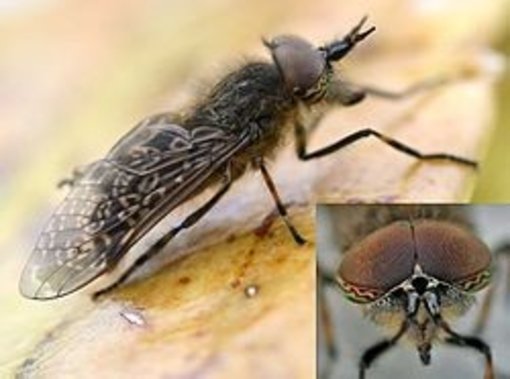
A horsefly.
HORSEFLY BITES.
Horseflies land quickly and bite almost immediately, usually causing noticeable pain. Besides this brief painful experience, bacterial infections are possible and can generally be treated with antibiotics. Horseflies bite rather than sting: they have no stinger. They are fast, reaching 25 km/h, and persistently pursue prey, sometimes for a kilometre. After biting, they cannot fly away quickly, so a well-aimed slap can kill them, though the bite has already happened and usually produces a large, itchy swelling. Their mouthparts consist of many blades that cut the skin. Unlike mosquitoes, they can therefore bite through some thin clothing, such as T-shirts, thin trousers and socks. Only females bite, to obtain enough energy to lay eggs. Livestock can suffer badly from horseflies. They occur mainly in somewhat damp places offering both sunshine and shade.
PREVENTING HORSEFLY BITES.
Covering clothing thick enough to prevent bites can reduce horsefly nuisance. Blood-seeking females use smell, warmth and movement to find prey. Sprays or lotions that create a scent barrier make prey harder to locate. Applying insect repellent can therefore work together with thick clothing that covers the body.
TICKS. Ticks are an order or family of parasitic arthropods belonging to the arachnids. Together with mites, they form the subclass Acarina. Familiar varieties include deer ticks, dog ticks, pigeon ticks, Nuttalliella and sheep ticks. These arachnids must fill themselves with blood three times in their lives. The sheep tick, Ixodes ricinus, is the most common tick in the Netherlands and feeds on many mammals, including humans, rather than only sheep. It is particularly known here as a carrier of Lyme disease. A tick moults and grows three times, needing a blood meal for each moult & growth stage and for egg-laying, usually from three different hosts. The first meal allows the larva to become a nymph; the next allows it to become an adult. The final blood meal is for laying eggs. Relatively few individual larvae complete their development, so females compensate by laying thousands of eggs.
A tick takes three to seven days to fill itself with blood. Once fed, it drops to the ground. Ticks conserve energy extremely well and can survive for more than a year without food or blood. They detect potential hosts through radiated body heat and possibly smell. A few months may pass before a tick again waits in ambush for a mammal, including a human, to provide its next blood meal.
DIFFERENT LIFE CYCLES
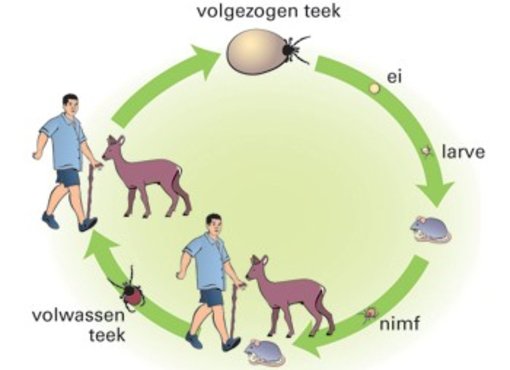
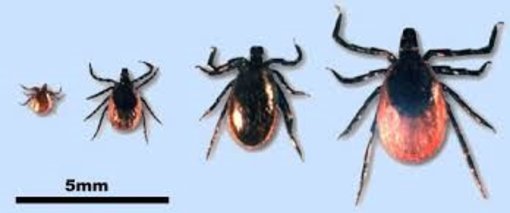
Sizes of ticks at different life stages.
PREVENTING TICK BITES.
Ticks can become active at outdoor temperatures of approximately + 6-7 degrees Celsius.
BITTEN?
In the Netherlands, around 20 percent of ticks carry Borrelia burgdorferi bacteria, also known as Lyme bacteria, which can cause Lyme disease.
Ticks acquire these pathogens when feeding on small rodents and birds carrying Borrelia burgdorferi. When a tick bites you, the Lyme bacteria are not transferred immediately. If you remove it correctly with the right tool within 24 hours, the risk of Lyme disease is very small; the risk then increases. An estimated 1 to 3 percent of tick bites lead to Lyme disease.
REMOVING TICKS.
POINTS TO NOTE DURING AND AFTER TICK REMOVAL.
LYME DISEASE.
Lyme disease is a bacterial infection. Its first sign is a red, ring-shaped rash around the bite, called erythema migrans. This ring or patch appears within 2 to 14 days of a bite from a tick carrying Borrelia burgdorferi, though it may sometimes take 3 months. Eventually it disappears by itself, but the bacteria may remain in the body and need treatment with antibiotics. If the bite is unnoticed or treatment begins too late, various health problems can develop. A blood test, which is expensive and counts towards your insurance excess, should establish whether you have Lyme disease. Go to your GP at the first vague symptoms. I understand that Germany is much further ahead in tackling Lyme problems. Now they just need to tackle those exotic, vicious rotten rats too.
SYMPTOMS AFTER AN UNTREATED TICK BITE.
Go straight to your GP at the first vague symptoms. Borrelia burgdorferi mainly affects nerve tissue, joints, skin and sometimes the heart. Symptoms vary between people and may include fatigue, flu-like symptoms, muscle and joint pain, forgetfulness and difficulty concentrating.
In the Netherlands, Lyme disease is usually associated with nerve disorders, such as nerve pain or nervous failure. This can lead to paralysis of the facial muscles or pain in legs and arms. In addition, people who have become infected with Lyme bacteria may develop joint infections, skin disorders and sometimes also cardiac arrhythmias. By the way, many people get Lyme disease, without a red circle appearing on the skin after a tick bite. So it's important to stay alert after a tick bite.
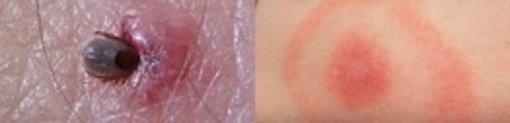
Tick bite and a red ring associated with Lyme disease.
OTHER RELEVANT CONDITIONS AFTER A TICK BITE:
- Chronic LYME
- Tick-borne encephalitis / FSME.
Biting midges are relatives of mosquitoes and have many Dutch regional names, including knutjes, knaasjes, knijten, mietsen, neefjes, meurzen and zandvliegen. They are very small, only 1 to 4 millimetres, and particularly favour water margins and wet, nutrient-rich grassland. Their larvae live in damp conditions such as pools in tree stumps, surface water and leaf axils. Like mosquitoes, they suck blood to produce eggs. Their bites can cause red patches and intense itching, with considerable nuisance and discomfort. Bites can also be dangerous: infection with a tropical filarial worm spread by mosquitoes can cause filariasis, particularly in Brazil, India and many African and Southeast Asian countries. Filariasis impairs drainage of fluid from tissues, causing swelling of the skin and limbs. Lymph nodes may also become inflamed, leading to bouts of fever.
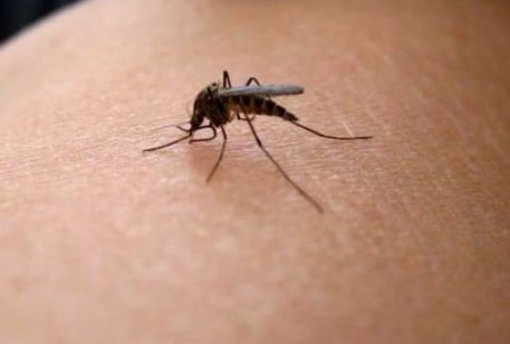
A biting midge.
PREVENTING MIDGE BITES.
Various natural-based insect-repellent sprays are available for protection against midges. They generally contain citronella and lemon-eucalyptus extracts and are suitable for people who do not want to use DEET or cannot tolerate it.
These sprays contain no DEET or other chemicals, making them ideal for small children from 2 -3 months and pregnant women. Special insect-resistant clothing treated with the chemical permethrin is also available. Cover exposed skin with clothing and a mosquito head net, and use a mosquito net for sleeping.
As already mentioned: Always apply insect repellent to your skin, preferably natural-based and without chemical DEET; see below.
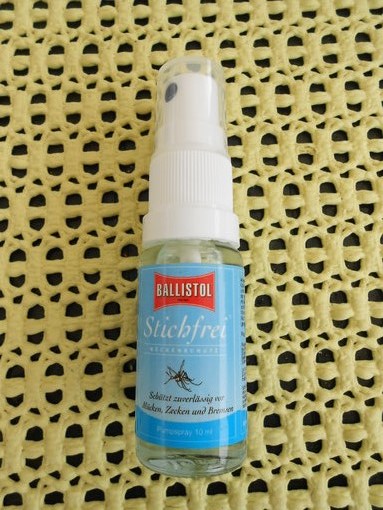
I used to use Ballistol Klever’s universal gun oil for everything; now its STICHFREI has joined the range. This versatile insect repellent is biologically based and dermatologically rated “very good”. We will see about that!
STICHFREI INSECT REPELLENT PUMP SPRAY (100ml).
DESCRIPTION OF STICHFREI:
Stichfrei protects for up to 6 hours against bites from midges, horseflies, botflies, mosquitoes, sandflies, tsetse flies, ticks and others. It also includes a UV-B filter and helps prevent skin dehydration. It has been used successfully worldwide, contains no harmful or irritating ingredients and is suitable for babies from 2 months. Dermatologically rated “very good”.
TEST RESULTS AND FINDINGS:
Stichfrei protected me very well during walks and testing activities in scrubland.
On this test day, I took my mountain bike and wore the Hill People Gear Original Kitbag, allowing quicker cross-country movement. Naturally, I thoroughly sprayed or applied Stichfrei, the natural-based insect repellent. I rode to explore a new area bordering or just inside a wildlife resting area. Beforehand, I studied it on Google Earth, then set off carrying a topographic map and my trusted Silva baseplate compass. I use electronic navigation only in the car. My aim was to cut branches and dry wood, peel and perform other tasks. These went very well in the forest (). Once I had had enough of the sandy surroundings, I put my kit on, mounted the bike and pedalled hard to the beautiful, quiet Boudewijn quarry. There I did more cutting and batoning, enjoyed the view and had a drink.
Then I moved on by mountain bike, first descending the high sandy hill onto a sandy path, crossing the N289 and continuing via the Groote Meer towards the Dutch-Belgian border. I performed more cutting tests there.
WELL PREPARED: Passing through narrow paths and dense vegetation would have given all sorts of parasites—not the Sheriff of Nottingham’s followers—free rein, had I not thoroughly applied Stichfrei. At my last resting point that day, hungry, overconfident insects approached from every direction, buzzing threateningly, but turned away in time. They really disliked Stichfrei! Once home, I checked for ticks, found none, then showered. After dressing, I maintained my equipment, including the Woodsman.
On another test day, I set off with the TT Trooper Light Pack backpack and attached TT Bottle Holder 1 litre, having applied Stichfrei again. Better Safe Than Sorry (BSTS). Stichfrei is easy to apply with its pump spray and gave me no rash or damage to plastic equipment, unlike a product containing a lot of DEET. It has some smell, but fortunately mosquitoes attracted to my sweat stayed away too, as they should with a very good insect repellent.
TIP: I would welcome a larger bottle: you use quite a bit when applying it thoroughly! (.
MY PERSONAL TEST RATING FOR BALLISTOL STICHFREI: /Very good.
SUMMARY:
Ballistol Stichfrei protected me very well during treks and testing activities in woods & scrubland. The pump spray makes it easy to apply, and it caused neither a rash nor damage to plastic equipment.
ACKNOWLEDGEMENTS:
Thanks to main sponsor Country Store in Epe for providing this insect repellent.
Knife expert Henk Kraaijvanger was an OPC/instructor at the KMA and a non-commissioned officer attached to the Force Protection Bureau. He is now retired.
From 1996, he was also knives editor for weapons magazines SHOOT and AK-56, and a freelance knife tester/writer for SAM until 1999.
He also designed the HKD sheath and is the current chair/member of the DKE jury.
Importers: do you have a knife or another edged tool you would like tested or reviewed? Perhaps you are a knifemaker, or just starting out?
Email us at [email protected] and we will tell you where to send your knife or axe.
 Lees in het Nederlands


 15% off
 15% off