MAKING A RAINPROOF TENT WITH THREE MILITARY PONCHOS.
Years ago, on a survival week in the Belgian Ardennes, we military survival enthusiasts—Henry, Gerard and I—carried our equipment, including firelighting supplies, rolled inside a sleeping bag in a rubbish bag, with an issued military poncho around it. Rolled waterproof like a toffee wrapper, it was carried over our shoulders. Back then, it was known by the slang term “berenlul”.
We deliberately took no food or water. Water was plentiful, though we usually purified it. Finding food in February was a greater challenge.
At the end of each long day’s hike, we scouted a possible bivouac site for troublesome locals and other problems.
Note: Do not use pits or ditches, because of possible flooding and descending cold, heavier air, or, in wartime and CBRN attacks, chemical warfare agents.
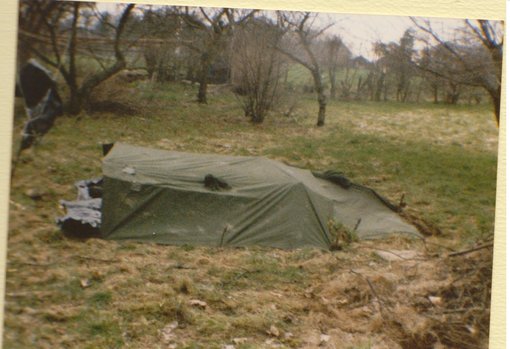
We then started work according to our agreed division of tasks. We quickly and skilfully made a waterproof tent from three military ponchos.
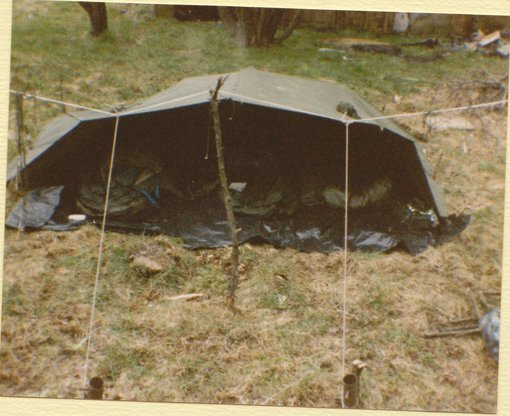
HERE IS HOW WE DID IT BACK THEN.
1. First we measured the size of the future tent and we drew the required tent surface.
2. After this we removed the ground surface of all kinds of stones, vegetation, branches, pine cones, acorns, etc.
3. We then prepared the poles we had found along the way or cut branches to use as supports and tent pegs.
4. We beat those supports in the ground, in a pre-determined place/position.
5. We stretched paracord support lines taut, or used branches or poles to support the three military ponchos.
6. We tied the poncho hoods closed so they were waterproof, then joined the ponchos with their press studs, eyelets and paracord: 2 ponchos side by side, with the 3rd attached crossways behind them.
7. Those ponchos we then laid over the tensioned para cords or the used branches/bars and pulled the whole over tight.
8. We hammered the tent pegs into the rocky ground using our Wilkinson Type D survival knives.
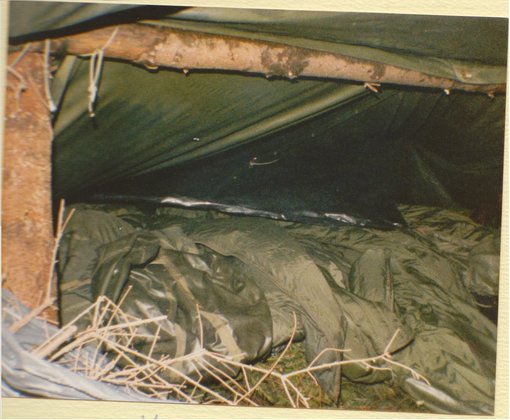
9. As an insulating layer in the tent, leaves, grass and hay were used.
10. That's where our sleeping bags were laid.
We usually slept dry and well in our poncho tent.
Note: We were well ahead of our time and needed no television weight-loss programme. After that strenuous week, I had lost more than 6 kg!
[i] Meaning of CBRN: carrying out or threatening attacks that endanger human life using chemical, biological, radiological or nuclear agents
Knife expert Henk Kraaijvanger was an OPC/instructor at the KMA and a non-commissioned officer attached to the Force Protection Bureau. He is now retired.
From 1996, he was also knives editor for weapons magazines SHOOT and AK-56, and a freelance knife tester/writer for SAM until 1999.
He also designed the HKD sheath and is the current chair/member of the DKE jury.
Importers: do you have a knife or another edged tool you would like tested or reviewed? Perhaps you are a knifemaker, or just starting out?
Email us at [email protected] and we will tell you where to send your knife or axe.
 Lees in het Nederlands


 15% off
 15% off