THE NEW SENTZ TICK OFF TICK REPELLENT.
By: Henk Kraaijvanger.
There is no doubt that you need to protect yourself against ticks, their bites and the dangerous consequences. I also think that public bodies, such as primary and secondary schools, should teach more about real nature and outdoor first aid, including tick awareness, during practical and biology lessons. Those “bloodsuckers” are also found on urban park lawns and at petting farms. And in those biology lessons, please also point out the almost certain connection between pupils’ daily routes and the “lost”, or rather discarded, plastic bottles, cans, crisp packets and sweet wrappers. Recently, outside a supermarket, I had quite an argument with a young would-be tough guy who threw the wrapper from a packet of cigarettes onto the ground in front of his three scooter-riding friends.
LYME DISEASE: I have personally experienced what Lyme disease can do to you. I picked up the tick bite and subsequent Lyme disease during one of my many field exercises as a military instructor, despite evening body checks. After removing the tick in what I believed was good time, and later noticing the notorious “Saturn” ring, I visited the doctor for a blood test. Lyme disease was diagnosed, as I had already suspected, and I was prescribed a two-week course of antibiotics. After I submitted an accident report, my Lyme disease was recognised as a service-related accident. To warn my military colleagues, I then wrote an article about ticks and their dangers for the army’s monthly magazine “De Onderofficier”. Now back to the present and Sentz’s more natural tick and mosquito repellent, Tick Off, fortunately without DEET.
Why do I say “fortunately without DEET”? During my many field exercises at the KMSL and KMA, I carefully applied the issued DEET-containing tick repellent, including to my forearms. Eventually, where my arms touched the coating of my RWW jacket, that chemical DEET stuff caused blisters in the coating and simply dissolved it. Needless to say, I switched to a natural tick repellent, even though I had to pay for it myself. Since then I have avoided DEET-containing tick repellents.
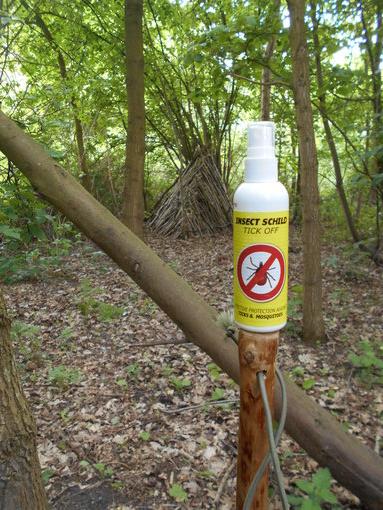
THE IDEAL TICK REPELLENT SHOULD:
- Offer 100% protection against a broad range of dangerous arthropods;
- Remain effective long enough: at least 8 hours for everyday use, though longer protection may be desirable for military operations, for example;
- Cause no irritation to skin or mucous membranes;
- Cause no systemic toxicity and be neither mutagenic nor carcinogenic;
- Resist sweating, abrasion and rubbing;
- Be odourless.
There is currently no remedy that meets all of these listed requirements, but some are close. Personally, I no longer like chemical DEET products and the impregnation permethrin that I have already used too much, so on to more natural products.
VriezzTrading, whose range includes very good outdoor brands for practical use, therefore sent me a free, but certainly not pointless, test pump bottle of Sentz Tick Off for a new review on bushcraft.nl. As always, without editorial instructions or dictated messages!
SPECIFICATIONS OF SENTZ TICK OFF.
|
NATURAL-BASED PROTECTION: |
Yes. |
|
ACTIVE INGREDIENT: |
IR3535 |
|
PROTECTS AGAINST: |
Effective against mosquitoes and ticks. Protects against other creeping and flying vermin. |
|
AVERAGE PROTECTION PERIOD: |
+ / - 8 hours, depending on exertion and outdoor temperature. Note: excessive sweating reduces the effectiveness of any tick repellent. |
|
SUITABLE FOR: |
Children older than 1 year and adults. An adult must apply the repellent to children up to 11 years old. |
|
WARNINGS: |
Bear in mind that this tick repellent is flammable when applying it. Take care not to spray into the wind and get the repellent or its vapour in your eyes, as it can cause serious eye irritation. |
|
ENVIRONMENTAL HARM: |
None according to the manufacturer. I cannot verify that in the short term. |
|
AVAILABLE AS: |
Aerosol cans of 50 and 100 ml. Pump sprays of 50 and 100 ml. |
THE ACTIVE INGREDIENT IR3535: Ethyl butylacetylaminopropionate (trade name: IR3535 from Merck KGaA) is an insect repellent. It is a carboxylic acid ester and an acetamide. It has been used for decades and is no longer patent-protected. Under European biocides legislation, the substance was assessed as an existing active substance and approved from 1 November 2015 for use in biocidal products of product type 19: repellents and attractants.
It is added to sunscreens and insect-repellent creams, sprays and lotions, among other products. It repels biting insects and mites, such as mosquitoes and ticks.
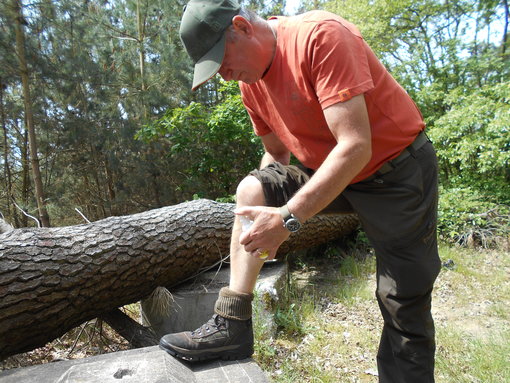
MY OWN FINDINGS OF TICK OFF DURING LONG TEST DAYS.
- Easy to apply using the pump, although I paid attention to the wind direction and kept it away from my eyes.
- Doesn't smell like much.
- Very effective so far: I have picked up no ticks on areas treated with Sentz Tick-Off, but have picked them up on untreated areas.
- No unwanted side effects such as redness or itching.
- No solvent action on plastic materials.
- During a long, unusual hike, with an unusual pose, I found a tick nymph on my untreated wrist, while the areas treated with Sentz Tick-Off—legs, abdomen/chest, neck and head—were tick-free.
- I did not find it particularly economical in use.
- I saw ticks walking off the treated part of my Pinewood outdoor/hunting trousers. The active ingredient does not kill them, although I dealt with them myself “in the Marie Antoinette manner”.
Conclusion: It was and remains mainly my personal preference to stop using DEET, which led me to Sentz Tick-Off this test year. During all my activities in woods and fields, Sentz Tick-Off insect repellent has worked very well so far, with no noticeable side effects.
TIP: Put the pump bottle in a zip bag, then store it in the top compartment of your backpack or in a trouser or jacket pocket.
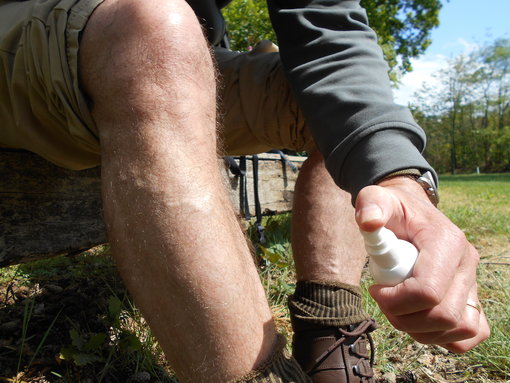
ACKNOWLEDGEMENTS: Thanks to John at outdoor & hunting gear importer Vriezz Trading for providing this Sentz Tick-Off insect repellent without editorial instructions.

 Lees in het Nederlands


 15% off
 15% off