There are two things no human can go without for long: first, of course, air to breathe, followed closely by water. That water must be drinkable, or life becomes an ordeal. You can carry enough for a day if it is not too hot, but not for several days or in hot weather. If you reach civilisation each day, refilling is straightforward. Out in nature, however, you need a way to make water safe to drink.
There are several methods: disinfection with tablets or drops; filtration; boiling; and UV light.
For bushcraft, you can rule out the last option straight away: it depends on a battery-powered electronic device. That is asking for trouble—remember Murphy’s Law.
What kind of problems can you deal with? With countless, but they can be accommodated in just a few groups:
- Bacteria
- Viruses
- Protozoa, single-celled organisms such as giardia and cryptosporidium
- Heavy metals
A decent filter removes those heavy metals, and the chance of finding them in a mountain stream is very small. Viruses are more difficult. Their average size is approximately 0,004 microns (0,000004 mm), considerably smaller than bacteria (0,2 - 0,5 microns) and protozoa (5 microns).
Most filters have pores of 0,1 to 0,2 microns, which are too large to stop viruses. This rules out, for example, the Katadyn Vario, Katadyn Pocket, MSR HyperFlow and MSR MiniWorks. There is only 1 filter with pores so small that even the tiniest virus, or any other impurity, cannot pass: the Frontier Pro.
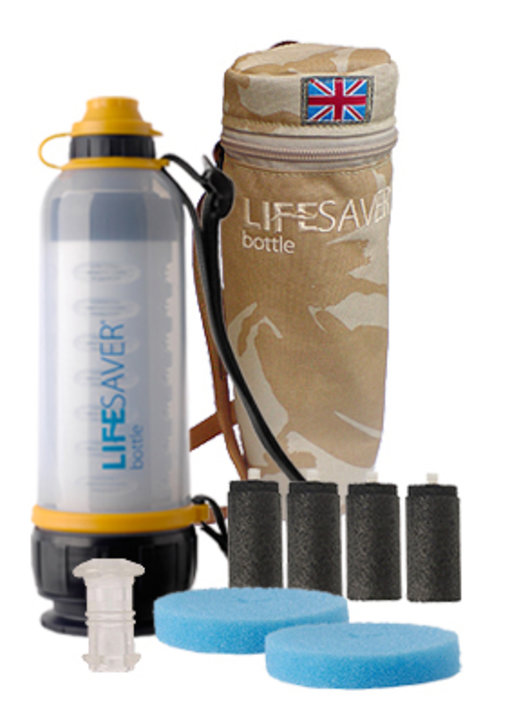
Another method is boiling water: actually boiling it, rather than merely bringing it to the boil. Boiling a litre takes about five minutes, then the water needs to cool, taking another 20 to 30 minutes. Remember that high in the mountains water boils at lower temperatures, sometimes 70 rather than 100°. That is not enough! Unless you cook on firewood, this uses considerable fuel every day. A stainless steel bottle offers an efficient, lightweight way to boil water over a wood fire. Remove the cap first…
Sometimes it is much easier to take a water-purification straw along. It is rather awkward to run out of tablets with another day or so still to go.
Chlorine drops are the cheapest option, but you will soon tire of them: it is like drinking a swimming pool. There is a solution, though: a Platypus or similar drinking system.
For pre-filtering, there are durable Millbank water filters. They remove coarse impurities, after which the water still needs boiling or treatment with a mechanical water filter.
The basis of good drinking water begins at the source, as it were. In the mountains there are the greatest risks of feces from cattle and wildlife. And do you think that cabin there is connected to the sewer? Look at your map where that stream you're standing with comes from. Around a cattle shed or something? Choose another water or use your filter or tablets.
Of course you don't make things worse than they already are and you don't poop or pee near a stream.
 Lees in het Nederlands


 15% off
 15% off